Posts

Showing posts with the label Training

Shrieking

Image
"EEEEEE!" my daughter shrieked shrilly in our cat's face. Calypso's ears flattened and she leaned away from the tiny, loud human.  This had been happening too frequently over the last few weeks for my liking. Calypso is wonderfully patient with our 1.75-year-old daughter, Lucy, with hardly a hiss when poked or prodded. But if the shrieking continued, I worried that someone would get hurt. My animal trainer mind began to analyze the behavior. Lucy's shrieking was becoming more frequent and that meant she was getting something enjoyable from it. What was reinforcing this behavior? I noticed that after shrieking, Lucy looked back at me. What did I do? I usually rushed to Lucy's side, gushing explanations. "Oh no, we can't scream at Calypso. That's scary for her. We can wave at her instead and say 'Hi Calypso.'"  Was my attention the reward Lucy was looking for? Next time I heard a shriek, I glanced over, modeled a quiet wave ("Hi Ca...

Chattering

Image
When I enter Otto's mew, I instinctually try to be as silent as possible. I don't want to spook the Great Horned Owl, after all. But then my mentor reminded me that predators slink along quietly. She suggested that I talk to him to make it clear that I'm not a predator trying to sneak up on him. I understood the assignment, but found it difficult. I'm a naturally quiet and concise person and have a hard time chattering away without a structured conversation. Otto keeps his eye on me when he has food enrichment in his talons. When my daughter was born, I got the same recommendation. You must talk to your baby to strengthen brain development and language skills. I was surprised how easy it became to narrate my day to a little human. Luckily my newly acquired parenting skill transferred into Otto's mew. Now I find a stream of words coming out of my mouth during training sessions as I describe where I'm moving, what the glove is doing, and what type of treats are in...

Visuals

Image
"I'm surprised that the birds seem relatively fine with the construction noise behind the mew," I told my raptor training mentor at our last check-in meeting. "They're little on edge when it's particularly noisy, but generally okay." "That sounds about right," she said. "Noises alone are usually less scary for raptors than seeing the action." A crew and heavy machinery across the street make Aldo a little nervous. Aldo the kestrel demonstrated this to be true last week. An excavator digging directly behind the building, out of sight? No problem. Aldo might pause before hopping on the scale, but he'll get there. A crew doing roadwork across the street, farther away but in view from his window? Scary! I entered the mew to weigh Aldo, but he was much too busy keeping an eye on the construction equipment and screeching his alarm call loudly. Any training would have to wait until the roadwork was done.

Predictor Cues

Image
I'm at the kitchen counter preparing dinner and my husband walks through the room. He wraps his arms around me and I nearly jump out of my skin because I wasn't expecting it. The surprise made even a sweet gesture not very enjoyable.  Now imagine I'm preoccupied with eating my meal and someone suddenly pokes me with a needle - my annual flu shot. Yikes! That would be very upsetting.  What if I knew that injection was coming? What if I could consent to it? Wouldn't that make the unpleasantness of a painful poke a little bit better? That's the idea with "predictor cues," a concept I learned from cat trainer Tabitha Kucera. One method she uses to give cats voluntary injections is Pet-Pinch-Poke . She says "pet," telling the cat that she is about to touch them. Then she says "pinch" before tenting the skin and "poke" before inserting the needle. The cat knows what is coming with each step, taking the surprise out of the interacti...

Training Archives

Image
Rummaging through old files, I found a treasure: the notepad where I recorded my first training sessions with Carson the Red-tailed Hawk.  When I first started at the Museum in 2016, I asked her to step on my glove (a behavior she had done with other trainers) and she ran away from me. We had such little trust that she wouldn't even eat in front of me. That was my first goal to overcome, highlighted at the top of the notepad:  To get to that point, I started by leaving a piece of food on a perch, stepping out into the hallway, and waiting for her to eat it. Sometimes she ignored it and I took the food away after 3 minutes. After a few tries she started eating the food. On the third day, she was waiting for me at our training spot, eager to take food! Carson waited for me at our training spot in 2016. We started with the bar pretty low. Since I took the time to start our training with the very basics, Carson gained confidence quickly. Fast forwarding to 8 months later, I found ...

Aldo's Behavior Plan

Image
Last week I wrote about using the ABC's of behavior to analyze Aldo's challenging behavior of flying to the door when Jenny or Heaven tried to enter his mew. After noting all of the antecedents and consequences that were associated with this unwanted behavior, we had to make a hypothesis and a plan to change the behavior. There seemed to be two consequences that could be driving the behavior. Was he flying to the door to chase the scary trainers away? Or was he trying to access his food more quickly? One of the antecedents on the list stood out to me: his weight was low. That seemed like a good indication that he might be feeling extra hungry and impatient to get his food, so we decided to test out that hypothesis.  Next we needed a plan to reduce the annoying behavior of flying to the door. We decided to: Feed Aldo extra food to increase his weight. Hopefully he wouldn't feel as desperate to get to the food. Remove the perch next to the door. If the perch doesn't exis...

ABC's of Behavior

Image
A few weeks ago, Jenny and Heaven let me know that Aldo the American Kestrel was giving them a hard time. Whenever they tried to enter the mew, Aldo flew to the perch in front of the door. They couldn't get in while he blocked the entrance. Normally I would toss out a few suggestions for Jenny and Heaven to try and see what happens, like throwing spaghetti at the wall. But this time I wanted to try a more structured approach.  A functional assessment is a detailed process that analyzes a behavior within the environmental factors that surround it. The structure is based in the ABC's of behavior: Antecedent : This is the "stage," everything in the environment that happens before the behavior. It can be broken down into the Distant Antecedent (relevant background conditions) and Immediate Antecedent (what immediately triggers the behavior).  Behavior : What does the animal do?  Consequence : What happens after the behavior? Does the animal gain something they wanted, li...

Training Wild Elephants

Image
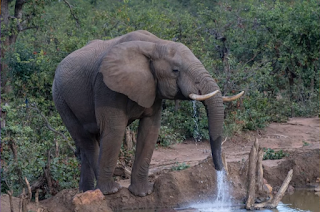
One thing that amazes me about animal training is that the basic principles can be applied to any animal. Dog, cat, hawk, fish, porcupine, and elephants. Even wild ones. Yes, you can change the behavior of wild animals in your backyard - or in Africa. Animal trainer Ken Ramirez has been working on a conservation project in Zambia to protect a dwindling herd of elephants. The herd's annual migration path meanders through Zambia where they are protected from hunting. But part of their path crosses the border into Democratic Republic of the Congo, where poaching is rampant. Many elephants are killed in this small section of their journey.  So the conservation team began to wonder if they could train the elephants to reroute their migration path to stay within the political boundaries of Zambia. Ramirez developed a training plan using the same principles that he would use to train a dog. First, they made the dangerous path more difficult by installing a tall stick barrier at a narrow s...

Training Snakes?

Image
Did you know you can train snakes? After finding some helpful videos on YouTube, I decided it's about time to try training with our snakes. The behavior we'll start with is a staple behavior for almost every animal I've worked with: targeting. The concept of targeting is simple: the animal simply has to touch an object, which is called the "target," and they get a treat. Carson the Red-tailed Hawk loves chasing after her target stick: I've even taught my pet rabbit to touch a mini-baseball bat and my  cat to touch my finger . So why not teach a snake to do it? I chose an object that would be clearly visible to our snakes. They don't have very fine vision and can only see blue and green, so I decided to try a blue lid made for cat food cans. The first step of our training plan is associating the target with food. They've never seen this blue lid before, so we want them to learn that the blue thing means tasty food is coming. When it was time to feed Em...

Choice of Words

Image
I was preparing for the first MuseumMobile school visit of the year and jotted a quick note for my coworkers on a post-it: "Please feed Aldo and Carson, but I'll train Otto this afternoon." Even though I was in a rush to leave on time, I paused, then added another word to my note so it read: "...I'll train with Otto..." How different are those phrases? Maybe not very different. But they have subtle meanings that can reflect how I approach animal training. "I'll train Otto."   This phrasing doesn't sit well with me because it feels more forceful. I feel like it means "I'll make him follow my commands." Traditional training methods come to mind. With dogs, that might mean yanking on their leash or using a prong collar. With owls, that might mean chasing them around the mew until they finally step on your glove. Not very fun for the animal. "I'll train with Otto." With . That one little word transforms this sentence...

Relationship Test

Image
Sometimes we need to be the bad guy. When that happens, I don a fluorescent trucker hat (the "bad guy hat"), safety glasses, and heavy welding gloves. Routine medical care requires this safety equipment and a brief period of restraint while I clip talons, replace leather equipment, and trim their beak. It was Otto's turn earlier this week. The whole event went smoothly and he returned to his freshly cleaned mew looking a little disheveled, but in one piece.  I checked in on his camera periodically over the next few hours to see how he was recovering. He looked just fine, if a little jumpy at noises outside. As our normal afternoon training time approached, I was nervous to find out how he felt about me. Would he be afraid of me now after I grabbed him? I cut up large chunks of mouse and prepared to do an easy session with Otto. The pattern games we've been practicing were the perfect way to test how he was feeling. I entered the mew with a little extra hissing from Ot...

Super Bowls for a Superb Owl

Image
I just can't get enough of pattern games. In addition to the 1, 2, 3 game , Otto the Great Horned Owl and I have been practicing Super Bowls. The original version of this game starts with a row of bowls on the floor. You start with your dog (or cat) at one end and wait for your pet to look up at you. When they do, you step forward and place a treat in the next bowl. That pattern is repeated while you work your way up and down the line of bowls.  Unlike 1, 2, 3 where it doesn't matter what the animal is doing, Super Bowls requires active engagement from your pet. They control when they move ahead by choosing when to look up at you.  I liked the idea of this game because I wanted to give Otto a way of choosing when he would go into and out of the crate. I also wanted a fun way to practice moving between perches because he had a tendency to get too comfortable in one spot and refuse to move. Bowls wouldn't work well in the mew, so I established an order of perches that we woul...

Processing Time

Image
I always hope for a timely response to cues during training sessions. When I ask Aldo to step on my glove, a behavior that he knows well, I want him to step up right away. If he doesn't, I know that he's not interested or distracted by something. For new behaviors, I'll give the birds more time to figure out what I'm asking them to do. I've found that Otto needs plenty of this "processing time." When I ask Otto to go in his crate, he has to think about it first. I know he's not ignoring me or saying "no" because he is still engaged. He needs to evaluate the distractions outside, check if there are any tidbits remaining at his feet, loosen up his foot if he thinks he has a piece of food, and figure out what I'm waiting for him to do. Once everything checks out, he's ready to hop in the crate.  The good news is that with practice, Otto's processing time is decreasing. Sometimes he walks into the crate right away, eager for more tid...

Shifting Gears

Image
Glove training wasn't working. Otto the Great Horned Owl was telling me repeatedly, "no thanks." So I had a decision to make. Would I continue training on the glove? I still had a hundred and one ways to change up my approach to see what would work for Otto. Or would I shift gears to try something new? I felt like I needed a break from the glove (and I'm sure Otto did, too), so I decided on a gear shift. After wiping off a layer of dust from the plastic, I hauled the bottom half of Otto's crate into his mew. Our new goal: crate training. If Otto could walk into his crate, in theory I could carry the crate into the classroom and he could walk out onto a perch during a program. He wouldn't need to sit on my glove at all! I was determined to set up Otto for success, so we started small in our first session. Would he enter the bottom half of his crate for a piece of food? I set a chunk of rat inside and he practically ran in to get it. Success! Now would he stay t...

Staying Calm is as Easy as 1,2,3

Image
When the tornado warning alert blared from my phone last week on my day off, I wasn't sure how worried to be. Just to be safe, I decided to move our "kids" - Wally and Calypso, our pet rabbit and cat - to an interior room of the house to wait out the storm. Wally got his favorite hay treats in his crate and I knew that would keep him happy for a while. Calypso, on the other hand, is not a fan of thunderstorms. She cried and pawed at the door of her carrier. To help her calm down, I played relaxing "music for cats" on my phone. She was still anxious and I remembered a trick I'd been practicing with Otto the Great Horned Owl. Just like I did with Otto , I started the 123 pattern game by saying "1, 2, 3" and offering Calypso a treat.  1, 2, 3, treat, 1, 2, 3, treat, 1, 2, 3, treat. Any animal, whether they are an owl or a cat, can find comfort in predictability and patterns. Calypso stopped trying to escape her crate and sat down to wait for the next ...

Creating a Focused and Confident Owl

Image
As a young animal trainer, I learned that "ABC" is all you need to know. The environment, or Antecedent , leads to a Behavior to get a certain Consequence . Simply by changing the antecedent or consequence, you can change behavior. That was always in my mind as I worked on glove training with Otto the Great Horned Owl. But I kept getting frustrated. It was like we were not speaking the same language. It felt more like I was coercing him to do something rather than teaching him to do it. I knew Otto was frustrated, too. I started thinking there must be another way to approach this, so I put out my feelers into the world of pet animal training. I learned about pattern games from a cat behavior consultant a few months ago. I was intrigued and ordered the book that started the pattern game trend. Control Unleashed: Creating a Focused and Confident Dog  by Leslie McDevitt arrived in my mailbox and I cracked it open to the first chapter, wondering if there would be anything useful ...

"Can you take out a bird?"

Image
"Can you take out a bird so we can see them?" I both enjoy and dread this question that I often hear from visitors. I love that people are interested in seeing our raptors and want to appreciate them. And I love showing them off. But the question can catch me off guard and make me feel flustered.  My answer is usually "no" for these impromptu requests. While it seems like a simple question, I realized recently that most people don't know all of the calculations I have to make in my head before I can give an answer. I can't simply pop a bird in and out whenever I feel like it. Here are a few things I need to consider before moving one of our raptors: Carson's crop is full and foot is tucked. She's not interested in stepping up after her meal. Have they already gotten their food for the day?  While not completely necessary, I prefer to have treats ready to reward them for stepping on glove and meeting an audience. Another problem is their motivation. I...

Timing

Image
Timing is important in animal training. That's why clickers have become a good way to teach new behaviors.  Imagine teaching a dog to sit without a clicker. You say "sit," the dog sits, and you deliver a treat. But other behaviors will happen in that time frame. By the time the dog gets the treat, he might have stood up, wagged his tail, made eye contact with you, and barked. How is he to know which behavior earned him the reward?  Now let's introduce the clicker. The dog knows that every time you click, he gets a treat. You say "sit," the dog sits, you click when his butt hits the floor, and you deliver the treat. The click told the dog, " that's what I want you to do. A treat is coming." It doesn't matter what he does after the click - he knows that the sit earned him the treat. The clicker is almost a magical tool, but it requires precision. What if you click half a second late when the dog is standing? He'll think you want him to st...

Engage-Disengage

Image
Last week I wrote about taking a big leap with Otto the Great Horned Owl. We stepped out the door! While it was a huge accomplishment, we still have plenty of work to do in this arena. Otto wasn't exactly happy with the new arrangement. Stepping outside was scary for him. Now we need to work to make the Museum backyard a positive place. In our next training session, I didn't even ask him to step on glove. I asked him to go to the scale, hop to a perch, fly back to his hutch. Easy, fun stuff is important to give him a break from serious training. If every session was really difficult and near his limit, he may not want to participate any more.  Then I started thinking: how could I acclimate Otto to the world outside the door without going through the door every time? What if we tried the Engage/Disengage game?  This pattern game was popularized by dog trainers that work with fearful or reactive dogs, but I actually learned about it from a cat behavior consultant. The idea is t...

We Did It!

Image
I am lucky to have two fantastic mentors at the moment. One specializes in cat behavior, while the other is a raptor-savvy trainer. They have both given me advice recently that, though different in context, was surprisingly similar. Essentially they said that you're never going to feel 100% ready for the next step; at some point, you just have to make the leap. When I set a goal date of stepping out the mew door with Otto the Great Horned Owl on my glove in two weeks, it sounded impossible. But I figured if my raptor mentor had confidence in us, I should have a little confidence, too.  I stepped into the mew on our goal date, forcing myself to act as if this session would be no big deal. I didn't want Otto to sense my nerves. I didn't feel quite ready to make a big move, but I knew I had to cross a mental threshold before we could get past the physical one. I could hear my mentors in my head saying, go for it ! And we did! We walked out the door!  I wish we had a better pho...